 Jenni Toriseva
Testing in the physical world — Prototypes, fit, unboxing and usability
Software can be tested in a browser. Physical products have to be held, worn, unpacked, charged and put away — by real hands, in real homes, over days rather than minutes. This is how I test hardware, with examples from Oura and Logitech.
- Companies
- Oura, Logitech
- Role
- Research lead — study design, prototypes, sessions and synthesis
- Methods
- Prototype testing, blind fit tests, in-home use, unboxing and setup observation, usability testing
Why physical needs its own testing
With hardware, the experience lives in the hands and the body: how something feels, how it fits, what it's like to open, set up and charge, and where it ends up when it's not in use. Much of that people can't put into words, and none of it shows up in a screen recording.
It also changes over time. A ring that feels fine for ten minutes can feel very different after a night's sleep, a workout or a hot day. So physical testing has to happen at the right fidelity, in the right place and for long enough.
How I test physical things
- Prototype at the right fidelity. Cardboard and foam for early ideas, 3D prints for size and form, finish samples for materials — just real enough to answer the question at hand, and cheap enough to change tomorrow.
- Let people handle, not just look. People try things on, compare them side by side and sort them on simple maps, explaining their choices out loud as they go.
- Test blind when looks would bias. When the question is about feel, people judge by touch alone, so a favourite colour or shape can't sway the answer.
- Test where things will be used. At home, on the desk people actually work at, with the cables and drawers and routines that are really there.
- Test over time. Wearing a prototype for days, or living with a product for weeks, brings up what a single session never will.
- Watch the first hour. Unboxing, sizing, setup and the first charge set expectations for months — so I watch them closely, without helping.
- Combine what people do with what they say. Video, observation and simple ratings sit side by side with interviews, so a team gets both the numbers and the reasons behind them.
Form and prototype testing
For Oura Ring 5, testing came in two rounds. In people's homes, sets of physical forms in different widths, thicknesses and profiles — together with material and finish samples — worked as provocations: people tried them on, compared them and sorted them by what they'd want to wear. A second round at the office, with prototype rings to try on, refined the width, thickness and profile.
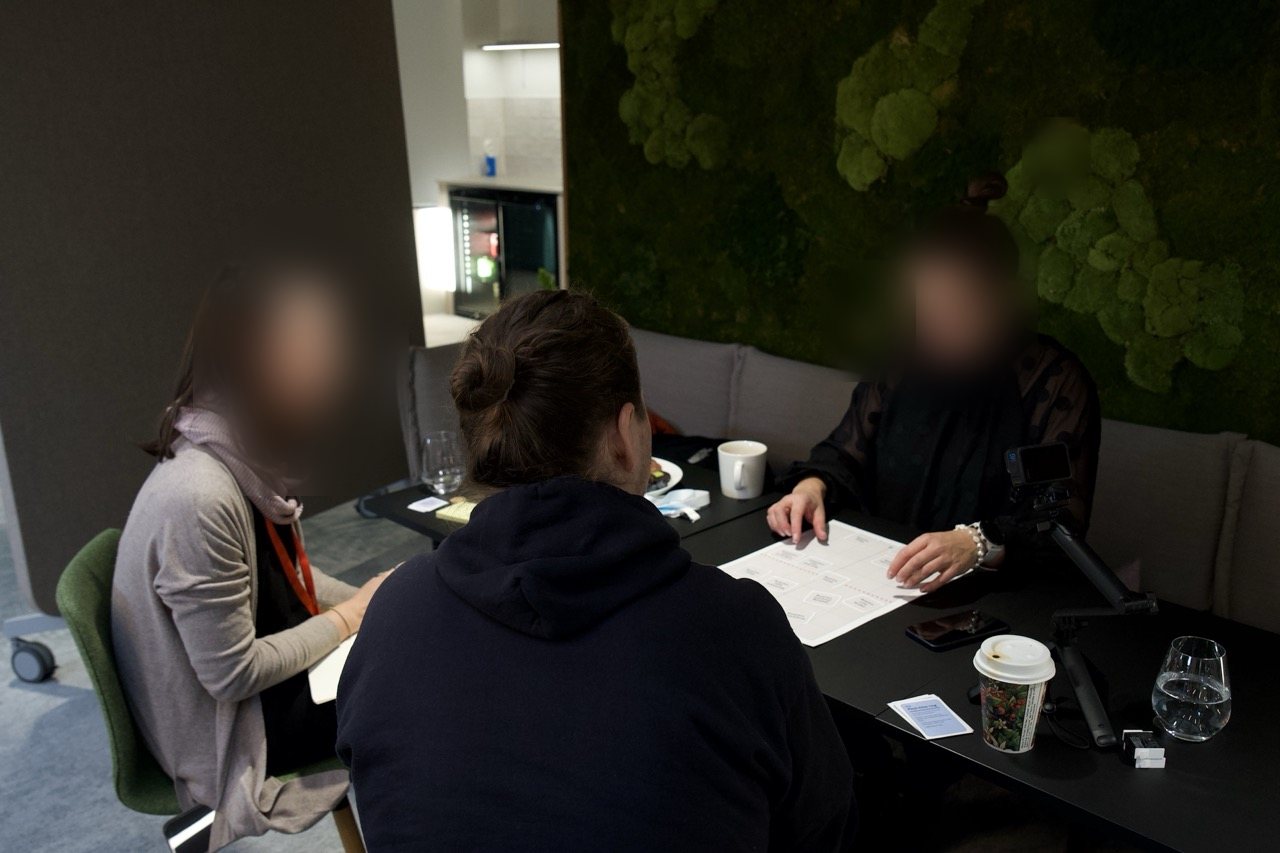
Each session followed the same structure, so results could be compared across people: try on, compare, sort, explain — with a researcher leading, a second taking notes and a small camera recording the hands.
Fit and comfort, tested blind
Fit is the hardest thing to test honestly, because people judge with their eyes as much as their fingers. For a sizing study, I designed a blind test: participants put rings on inside a closed box and judged them by feel alone, with a small camera recording their hands. A baseline with their own ring, and the same order of questions for everyone, made the answers comparable.
The whole study, and what we learned about hands, is on the Designing for comfort page.
Unboxing, sizing and setup
The first hour with a product sets the tone for everything after. In research on the Oura member journey, we visited members at home and asked them to walk us through it as it really happened: ordering, the wait, the sizing kit, unboxing, setup, the first charge — and where everything lives now.
I look for the moments people hesitate: what they read and what they skip, what they expect to happen next, what they do with the packaging and leftover parts, and where the charger ends up. Small physical details — a cable that's too short, a box with no obvious next step — can colour how people feel about the whole product.
Unboxing can also be the study itself. For Logitech's work-from-home research, participants received a kit at home and filmed themselves opening it and setting it up for the first time — then used it for a week and kept an emotional diary of their working days.
Usability testing at home
When the people you design for have very different bodies and abilities, the lab is the wrong place to test. For Logitech's accessibility work, we tested lo-fi mockups of input devices with people in their own homes, at their own desks and with their own set-ups — iterating between rounds as fast as the mockups could be rebuilt.
For Logitech's sustainability research, physical product and packaging mockups worked the same way: something to hold and open makes abstract ideas about circularity and packaging concrete enough to react to.
What it gives a team
- Evidence early, while changing a dimension or a material is still cheap.
- Specifications grounded in bodies, not averages — like the dimensions behind Oura's rings.
- The out-of-box experience seen from the outside, with the small physical frictions that are easy to miss from the inside.
- Shared conviction: video of real hands and real homes settles debates that slides can't.