 Jenni Toriseva

Foundational research — Uncovering needs and barriers to find opportunity spaces
Before a product has a shape, the most useful thing research can do is widen the view. Foundational research looks past what people say they want, to how they actually live — their goals, habits, workarounds and the barriers in their way. This is how I approach it, with two studies at Oura as examples.
- Company
- Oura
- Role
- Research lead — planning, fieldwork and synthesis
- Year
- 2023–2024
- Methods
- Remote diary, home interviews, participatory props, synthesis
Why start wide
Evaluative research asks does this work? Foundational research asks what is worth making — and for whom?
It is most valuable early, when a team has a hunch but not yet a product, and the cost of being wrong is still low. Its job is not to confirm the hunch but to hold it up against real lives: to find what people need, what gets in their way, and where the real opportunities are — sometimes somewhere else entirely.
The examples on this page come from two studies at Oura: the discovery research behind Oura Ring 5 in 2023–24, with 24 people in the Helsinki region who didn't own a smart ring yet, and an earlier-stage study in 2024 with people who already track their health closely.
How I work
- Start from the hunch, then question it. I write down what the team already believes — about the people, their needs and the product — as explicit assumptions, so the research can confirm or reject each one instead of quietly absorbing them.
- Ask about life first, product second. The key questions cover people's wellbeing goals, strategies and barriers before the hardware and software experience. A product only makes sense in the context of the life around it.
- Pilot, then go deep. A small pilot round tests the method and the recruitment criteria; what we learn shapes the main study.
- Let people document their own lives. A remote diary before the visit captures routines, data and frustrations as they happen, and gives the interview a starting point.
- Go to their home. Long interviews where people live show the gap between what is said and what is done — the spreadsheet on the phone, the device in the drawer.
- Make the abstract tangible. Simple printed props and wooden blocks give people something to point at, move and argue with.
- Synthesise into opportunity spaces. Needs, barriers and strategies come together into areas worth designing for.
Inside people's homes
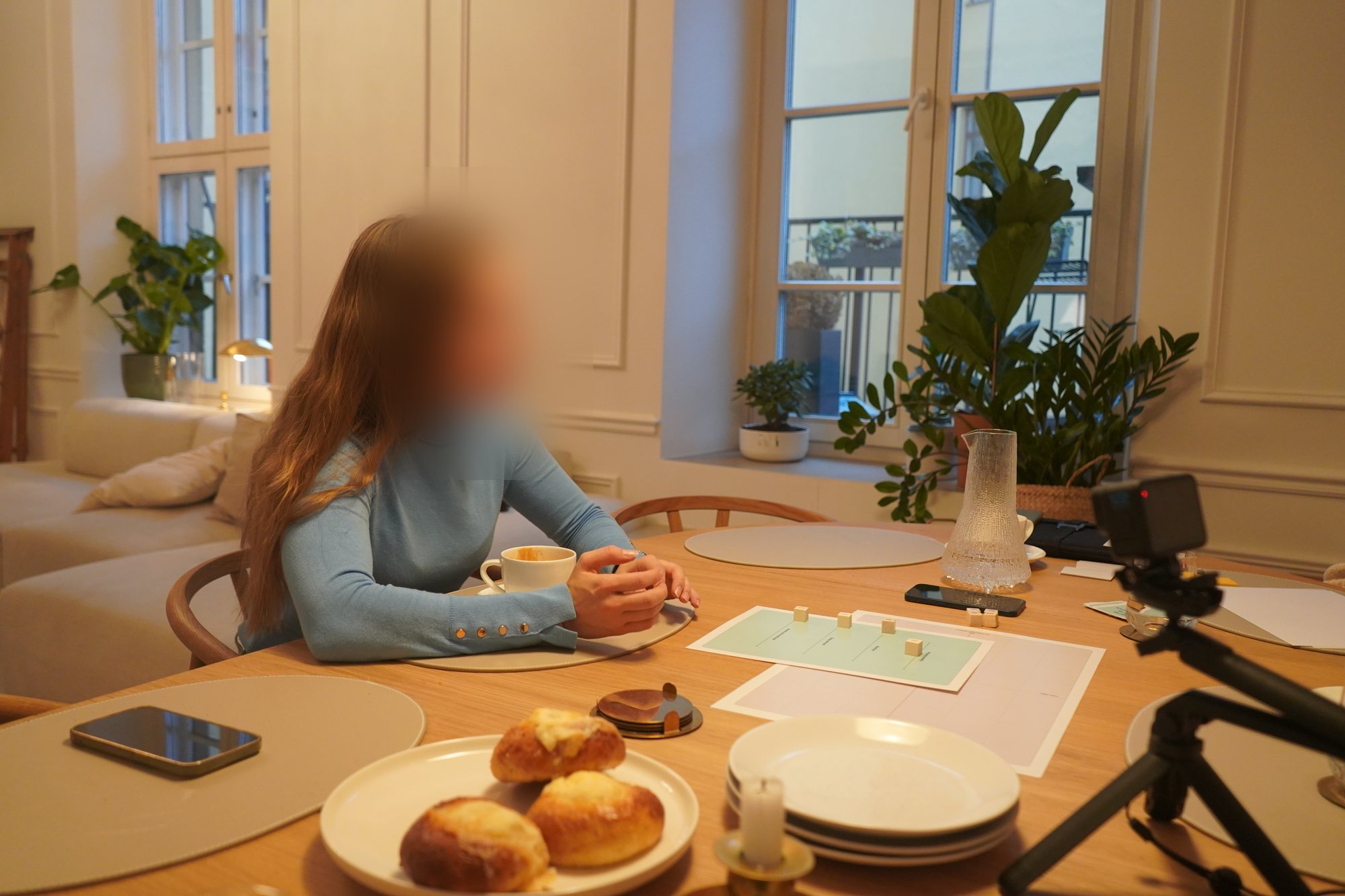
Home interviews are at the heart of this kind of research. For Oura Ring 5, each visit followed a seven-day diary and lasted about an hour and a half, at the participant's own kitchen table.
The first part is never about the product. We talk about their days: routines, what they already do for their health, the devices and apps they use and the ones they've given up on. Asking people to show rather than tell — where things live, what they take off and when, how they wash their hands — brings up details nobody would think to mention in a meeting room.
People also bring their own data. One participant showed us a spreadsheet tracking their days in detail — a workaround like that says a lot about what someone really needs.
Props that make the abstract tangible
Wellbeing is hard to talk about in the abstract. Printed props turn big questions into small, concrete decisions — and give me comparable material across participants:
- Scales for how people approach their wellbeing, from relaxed to determined, and how well they feel they know their own body.
- Wellbeing aspects, where wooden blocks mark how they're doing in physical activity, nutrition, sleep and rest, and mind and emotions — with room to add what's missing.
- A typical week, filled in from the diary, to see where health actually fits in real schedules.
- Journeys: their health and wellbeing from birth to today, and the emotional highs and lows along the way.
- A body map, where people mark the devices they wear today and where on the body they wear them.
- Relevance maps, where people sort ideas by how relevant they are to them and what they'd consider first.
The blocks are deliberately low-tech. Moving one is a decision, and people explain themselves as they make it — which is where the interesting conversations start.
From needs and barriers to opportunity spaces
In synthesis I look at every participant through the same three lenses:
- Needs — both the conscious ones people name, and the unconscious ones that only show in what they do: the rest they keep postponing, the parts of life that get crowded out.
- Barriers — what gets in the way: time, habits, knowledge, motivation, and the friction of the technology itself.
- Strategies — what people already do to get around those barriers, from routines to the systems they build for themselves.
Where a strong need meets a barrier nobody solves well — and people's own workarounds show how much they care — there is an opportunity space. I describe each one in people's own words, with evidence from the interviews, so the team can weigh it for themselves rather than take my word for it.
The props make people comparable, too. Laid side by side, everyone's answers show patterns that no single interview does — like the gap between how important a part of wellbeing feels and how much effort people actually put into it.
What the team gets
A foundational study gives a team more than a report:
- a deeper, shared understanding of the people they design for, with a profile of every participant;
- their assumptions confirmed or rejected, with evidence;
- opportunity spaces to explore, and a recommended design target;
- early design principles to guide the first concepts.
For Oura Ring 5, the research defined who the ring was for and what it should feel like on the hand — the whole story is on the Oura Ring 5 page. The 2024 study gave the team a shared picture of the people they wanted to serve, and the starting point for the discovery research that followed.