 Jenni Toriseva

Designing for comfort — Anthropometry for rings worn day and night
A smart ring has to be comfortable on every kind of hand, around the clock, while staying close enough to the arteries to measure accurately. Comfort is hard to design for because people can rarely say what makes something comfortable — they feel it. My work on comfort combines anthropometric data, careful measurement of real hands and studies where people judge fit by feel alone, and turns the findings into principles the whole design team can build on.
- Company
- Oura
- Role
- Research lead — anthropometrics & comfort
- Years
- 2024–2025
- Methods
- Hand measurements, blind fit tests, at-home wear, literature review
Why comfort is hard
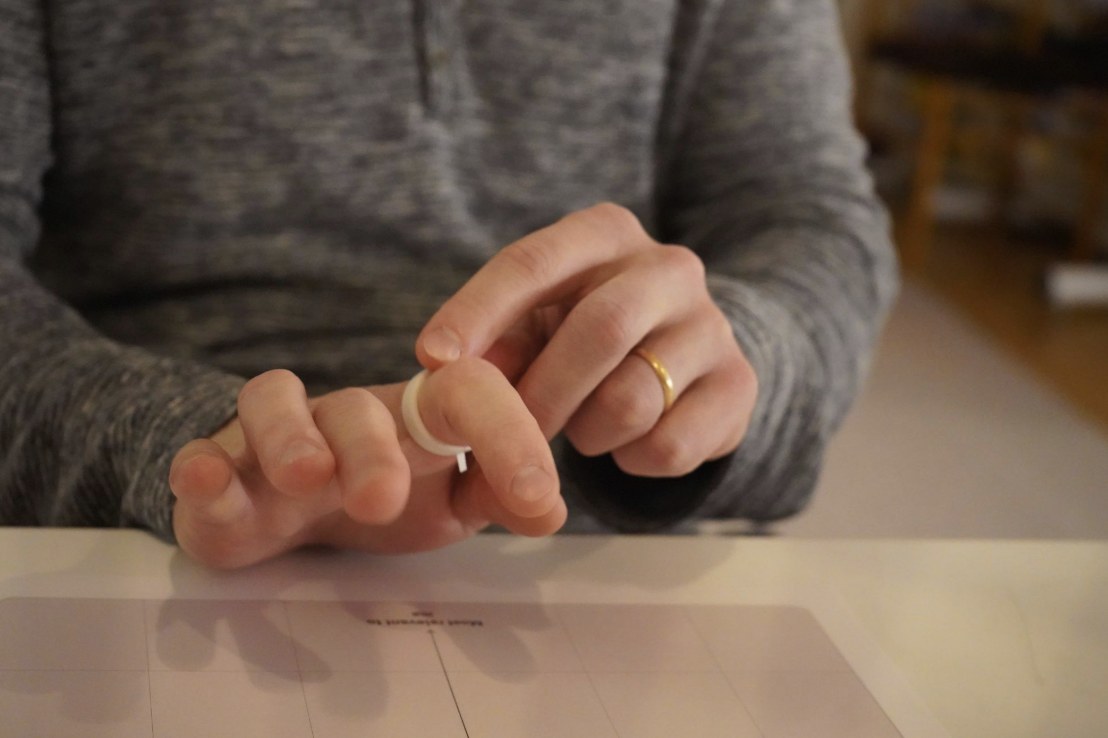
Hands vary enormously — in size, in finger shape, in how knuckles compare to the base of the finger, and in how much they swell over a day and with the temperature. People with small hands found rings bulky; people with large knuckles struggled to find a ring that was easy to put on yet snug enough to measure well.
Comfort is also hard to ask about. People notice discomfort, but rarely the details that cause it, and what they say in an interview often differs from what their fingers tell them over a day of wear. So I design studies that measure the body, and let people judge with their hands rather than their eyes.
How I work on comfort
- Start from the data. Anthropometric tables and human factors research show the range of bodies to design for — not just the average.
- Measure real hands. The circumference of each finger at the knuckle and at the base, on both hands, and standardised photos of every participant's hands.
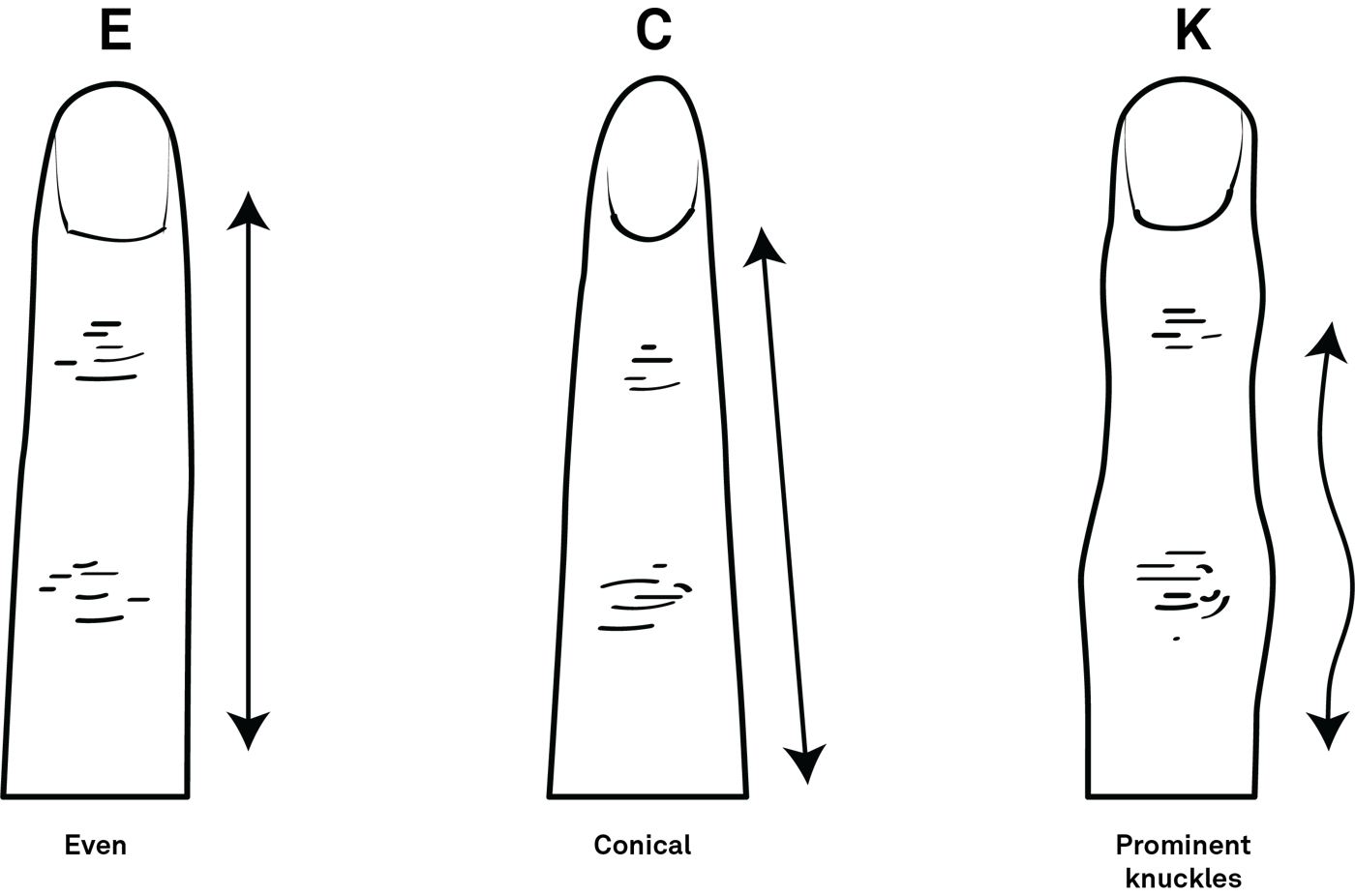
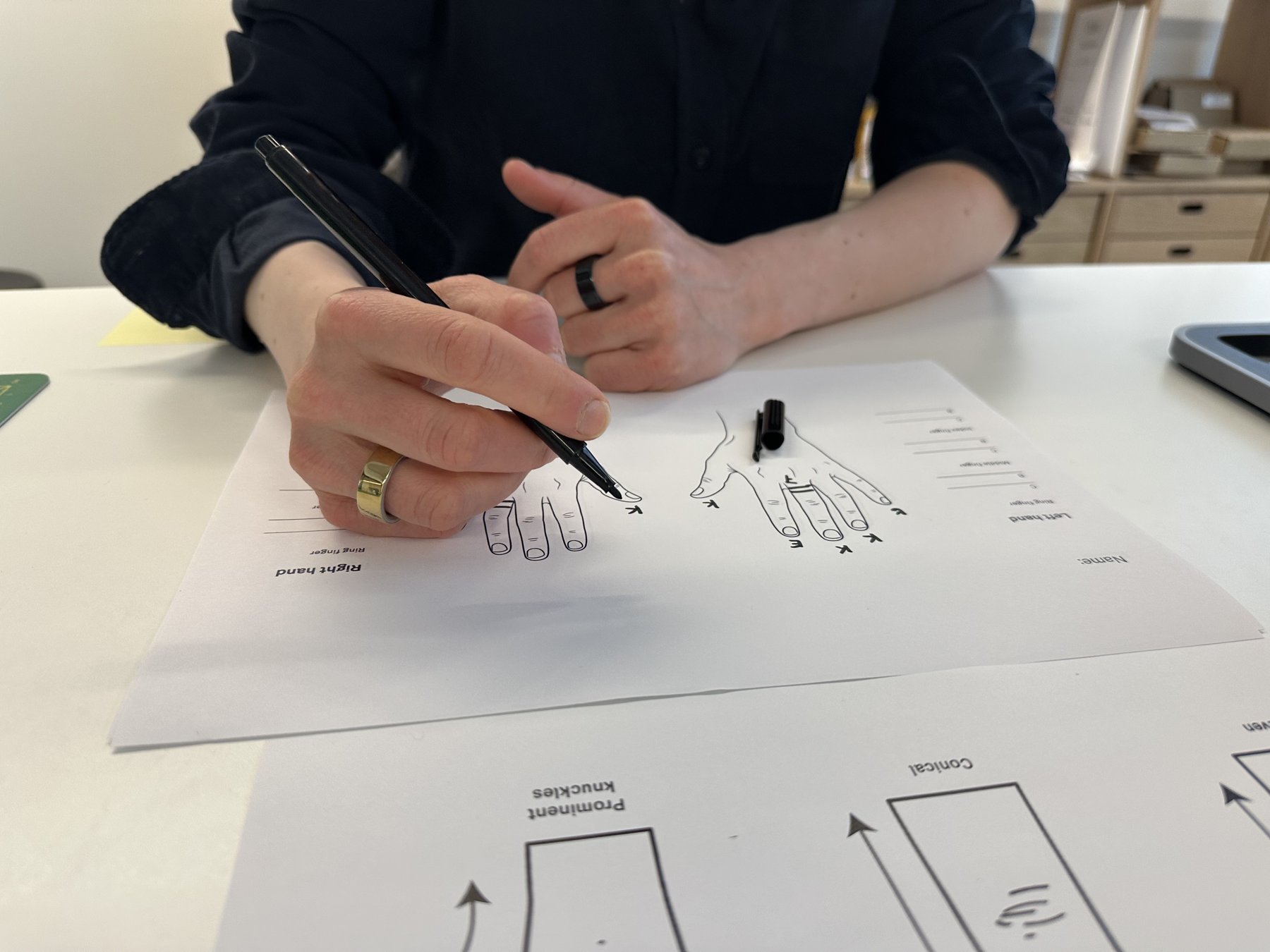
- Classify the shape, not just the size. People assess their own fingers as even, conical or big-knuckled, using reference drawings — because the same ring size fits these fingers very differently.
- Judge fit by feel. In blind tests, people try rings they can't see, so looks and expectations don't colour how a fit feels.
- Test over time. 3D-printed mockups worn at home for days, with a diary and finger measurements across the day, catch what a 30-minute session can't.
- Turn findings into principles that designers can apply — written, illustrated and shared across the team.
Reading the hand
Size alone doesn't predict fit. A ring that sizes well at the base of the finger can be a struggle to get over a big knuckle, and slide straight off a conical finger in the cold. So alongside measurements, I ask people to look at their own index, middle and ring fingers and classify each one — giving us a shared, simple vocabulary for finger shape that designers and participants both understand.
A blind fit study
When a ring is redesigned, a person's size should still feel like their size. For a new ring in development, I designed a study to find which size variant of the new design felt the same as the current ring — so that people moving from one to the other would get the fit they expect.
- 20 colleagues, 10 women and 10 men, covering ring sizes 6 to 15 and all three finger types.
- Hand photos and finger types: photos of both hands, open and closed, and a self-assessment of each finger with the reference drawings.
- Baseline fit: each person found their best-fitting current ring on the index, middle and ring fingers of both hands, and rated how well it fitted.
- Blind comparison: inside a cardboard box, out of sight, people tried size variants of the new design against their baseline and chose the closest match — by feel alone. A camera recorded their hands, so we could look back at how they handled each ring.
What people felt
Fit is felt at the knuckle. Once a ring was on, people could barely tell the variants apart. The differences came through when putting a ring on and taking it off.
Hard to put on reads as too small. When a ring was harder to slide over the knuckle, people picked a larger size — even when the fit on the finger itself was right.
People fidget. Many take their ring off and put it back on throughout the day, so how easily it comes off is part of how its fit feels. A ring that's hard to remove feels constraining.
The study gave the hardware team a clear recommendation on which variant to take forward, and a reminder that comfort has to be designed for the whole ritual of wearing a ring, not just the moment it sits on the finger.
“I tend to fidget with my ring throughout the day, and that's where I really notice the size. When the ring is really tight I feel a tiny bit panicked.”— Study participant
From research to principles: The Hand Book
Knowledge about hands and comfort was scattered across studies, people and prototypes. I brought it together in The Hand Book: a manual that gives Oura's designers — including new ones — a shared understanding of the human hand, and turns research into principles for designing rings people forget they're wearing.
I built it from a literature review of hand anthropometrics and human factors, measurements of my research panel's hands, 3D-printed mockups tested at home and in the office, and longitudinal wear with diaries and finger measurements across the day — then wrote and illustrated it so the principles are quick to grasp and easy to apply.
What the hand teaches us
Fingers aren't round. Especially at the base, where a ring sits, fingers are flatter than a circle — yet rings have always been round, out of tradition and ease of manufacturing.
Not every finger is equal. The index finger offers a good combination of comfort and sensing: enough tissue over the arteries, and often a knuckle no wider than the base. Many people still choose the ring finger out of habit, where a bulkier ring sits tightly between neighbouring fingers.
Finger shapes create different problems. Big knuckles make a ring hard to put on and take off, and a loose fit lets it spin and lose accuracy. Conical fingers let a ring slide off, especially in the cold.
Small hands are the hardest to design for. Bulk between the fingers stops them closing together — the moment a ring starts to feel like a device.
“Five ingredients make a ring comfortable: its thickness, width, profile, cross-section and the material against the skin.”— The Hand Book
1 · Thickness
Keep the ring thin where it matters: between the fingers and near the palm, where bulk is felt when making a fist.
Where bulk can go
If the ring needs more volume, the top of the finger is free space — it adds bulk without costing comfort.
2 · Width
Follow the golden middle. Too narrow concentrates pressure; too wide traps moisture and gets in the way of bending the finger.
3 · Profile
Follow the finger's natural shape rather than a perfect circle — a better fit, and less spinning that moves the sensors away from the arteries.
4 · Cross-section
A rounded inlet slides over the knuckle and lets the skin breathe. Varying the cross-section puts bulk where it isn't felt.
5 · Inlet material
The surface against the skin decides how a ring feels: cool, hard materials slide on easily, are kind to skin and feel higher in quality.
A living handbook
The Hand Book is written for designers to use: as onboarding for new team members — as a deck, a self-read or an audio highlights version, in Finnish and English — and as a reference in the team's design bootcamps.
The first chapter covers ergonomics and comfort. The structure leaves room for the next ones: aesthetics and emotional fit, usability and interaction, and accessibility and inclusivity — each combining human factors with design principles.
Ergonomics & comfort
How hands are built and how a ring should fit them: anatomy, finger types and the five ingredients of comfort. The first chapter.
Aesthetics & emotional fit
How a ring's look and feel decides whether people want to wear it, and how they feel when they do.

Usability & interaction
How people handle, put on and interact with a ring in everyday life.
Accessibility & inclusivity
Designing for the full range of hands, bodies and abilities — not just the average.
Outcome
Together, this work helped define the dimensions of Oura's rings, including Oura Ring 5, and gave the hardware team a shared, growing foundation for designing rings that fit the full variety of human hands — and the way people actually wear them.