 Jenni Toriseva

Biofonia — Citizen science to mitigate biodiversity loss
The natural world is becoming quieter, and we're not listening. Biofonia is a service and product ecosystem that connects people to a place in a nature reserve, so that through listening they learn its wildlife's daily and seasonal cycles — and how everything is connected.
- Context
- MFA thesis, Interaction Design, Umeå Institute of Design
- Role
- Solo project
- Duration
- 4 months, spring 2016
- Methods
- Exploratory research, concept validation, usability testing, service and interaction design
The challenge
Together with climate change, biodiversity loss is perhaps the biggest challenge humanity has faced, yet many people struggle to grasp how far-reaching and serious it is. As we've become more urban, we've become less attuned to noticing the changes happening in the natural world.
Environmental psychologists call it the extinction of experience: city dwellers have fewer and fewer encounters with nature. With fewer encounters, we relate less to the natural world — and what we can't relate to, we find hard to value.
“How might we help people understand biodiversity loss, and give them a sense of agency in combating it?”— The opportunity
How I worked
The concept grew from expert and user insights gathered with ethnographic methods, then went through rounds of lo-fi prototyping and testing.
- Workshops with experts in outdoor education, mapping how they see people's relationship with nature and how interest in nature changes through life.
- Interviews with 20 people from the target group, who brought one to three photos or drawings of their current relationship with nature.
- A diary study tracking how much and how people spent time outdoors, used as the starting point for each interview.
- Experience safaris — a biology class, a nature museum tour and a wildlife-tracking course — to experience how nature is presented to people.
- Visual provocations: photos of nature that participants wrote questions about. "Why" questions showed curiosity about how nature works; "how many" questions showed people struggling to know what to ask.
- Ideation workshops with experts and target users.
- Experience prototyping, lo-fi experience tests with an Arduino and recorded nature sounds, paper wireframe testing, form exploration in nature, and light interaction testing with a working prototype.
Visual provocations
Research diaries
Participants filled in diaries tracking how much, and how, they spent time outdoors. Their entries became the starting point for each interview.
Experience prototype: the gift kit
For the second experience prototype, "Nature calling", participants received a kit as a gift. They took a birdhouse standing in for the Collector to a place that mattered to them, or to mark a special occasion.
Experience prototype: the sound box
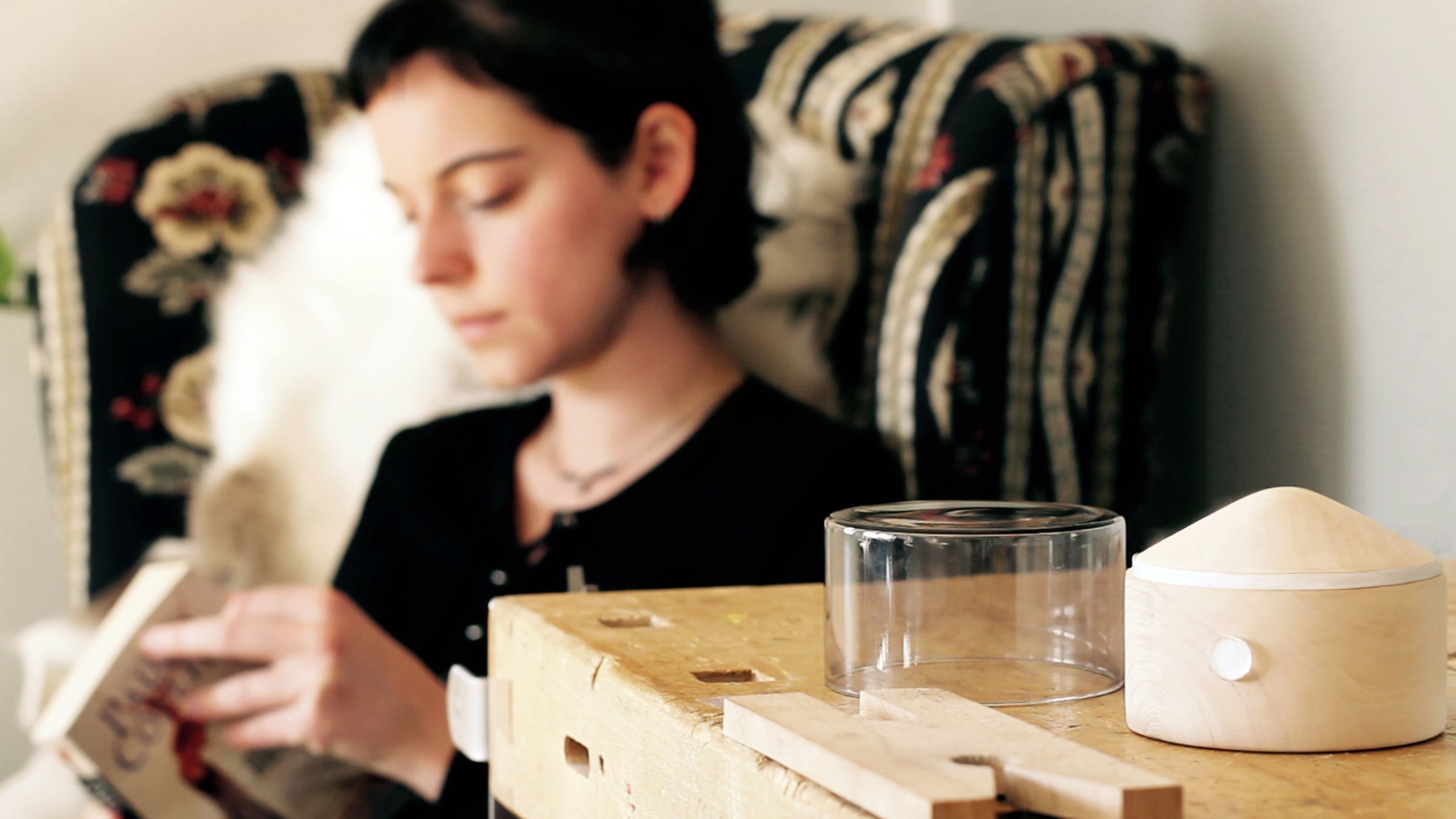
Back home, a wooden "sound box" standing in for the Biophone let them listen to the place for four days, while they kept a diary. Picking the box up made people think of the place before they even listened — "like a postcard to it."
Synthesis
What I learned along the way
An early concept asked people to record nature sounds themselves while outdoors. Testing showed that the recording got in the way of the experience, so I dropped it.
The lo-fi listening test showed that long silences were the real barrier: people needed to know when to listen. That led to using light to signal sound activity at the site.
The outcome: Biofonia
Biofonia works with organisations creating new protected areas, and acts as a bridge to people who want to support them. Over time, listening to one place teaches you to notice when something is out of sync — when a species arrives late, doesn't arrive at all, or a new one appears.
The ecosystem has three parts:
The Collector
An environmental monitoring device that records the soundscape in a nature reserve of the patron's choice. The patron can listen to it in real time, online on the Mesh or with the Biophone.
Reserve staff trained in soundscape ecology guide each patron on a hike to set up their Collector, analyse the site, and introduce them to how sounds are read on the Mesh. Its data helps scientists identify species and estimate biodiversity, and the patron's fee helps fund the reserve.
The Collector, set up in the forest
The Mesh
An online platform that stores everything the Collector records and connects listeners, scientists and reserve staff.
It recognises species the listener has already identified, but deliberately leaves new sounds for them to learn — both to build reliable data for science and to make listening a learning experience. Unknown clips can be posted for experts to help interpret.
The Mesh, in use
The Biophone
Sits at home and helps build a habit of listening. Its light glows with the site's real-time sound activity, so people learn its daily and seasonal rhythms even through long silences.
Lift the lid to open the live audio stream; press the button to mark a sound to find later on the Mesh.
Service blueprint
The full blueprint maps what the patron does at each stage, what they see and touch, and what nature reserve staff, scientists and the platform do behind the scenes. Click to open it large and zoom in.
The service journey
From choosing a nature reserve and personalising the kit, to a guided hike to set up the Collector, to listening and recognising species at home — and what happens when the subscription ends.
A sense of agency and hope
At a time when biodiversity loss is one of the most pressing problems we face, it isn't enough to make people aware of it. Biofonia gives them a way to help — by protecting a place, and by learning to listen to it.
Read the thesis
Loading…
Biofonia: A citizen science service to monitor biodiversity · MFA thesis, Umeå Institute of Design, 2016